
Why water retention matters in coating processes?
Why water retention matters in coating processes?
Water retention is one of the most important—but often overlooked—parameters in coating processes. While viscosity, solids content, and coat weight receive significant attention, water retention has a direct impact on coating quality, machine runnability, drying efficiency, and production costs.
Two coating formulations may have nearly identical viscosity and solids content but behave very differently on the coating machine. One of the key reasons is how quickly water leaves the coating color under pressure.
What is water retention – and how is it measured?
Water retention describes how well a coating color retains its water phase when pressure is applied during coating. In practice, it determines how much water remains in the coating layer and how much penetrates into the base paper or board.
The most widely used method for evaluating water retention is the TAPPI T701 pressure filtration test, where the amount of water removed from the coating under controlled pressure is measured.
ACA Flow WR is the newest generation water retention analyzer designed according to the TAPPI T701 method. It combines fast measurements, an intuitive touchscreen interface and excellent repeatability in a highly user-friendly instrument. For laboratories currently using older water retention analyzers, ACA Flow WR offers a significantly faster and more convenient testing experience while maintaining reliable and accurate results.
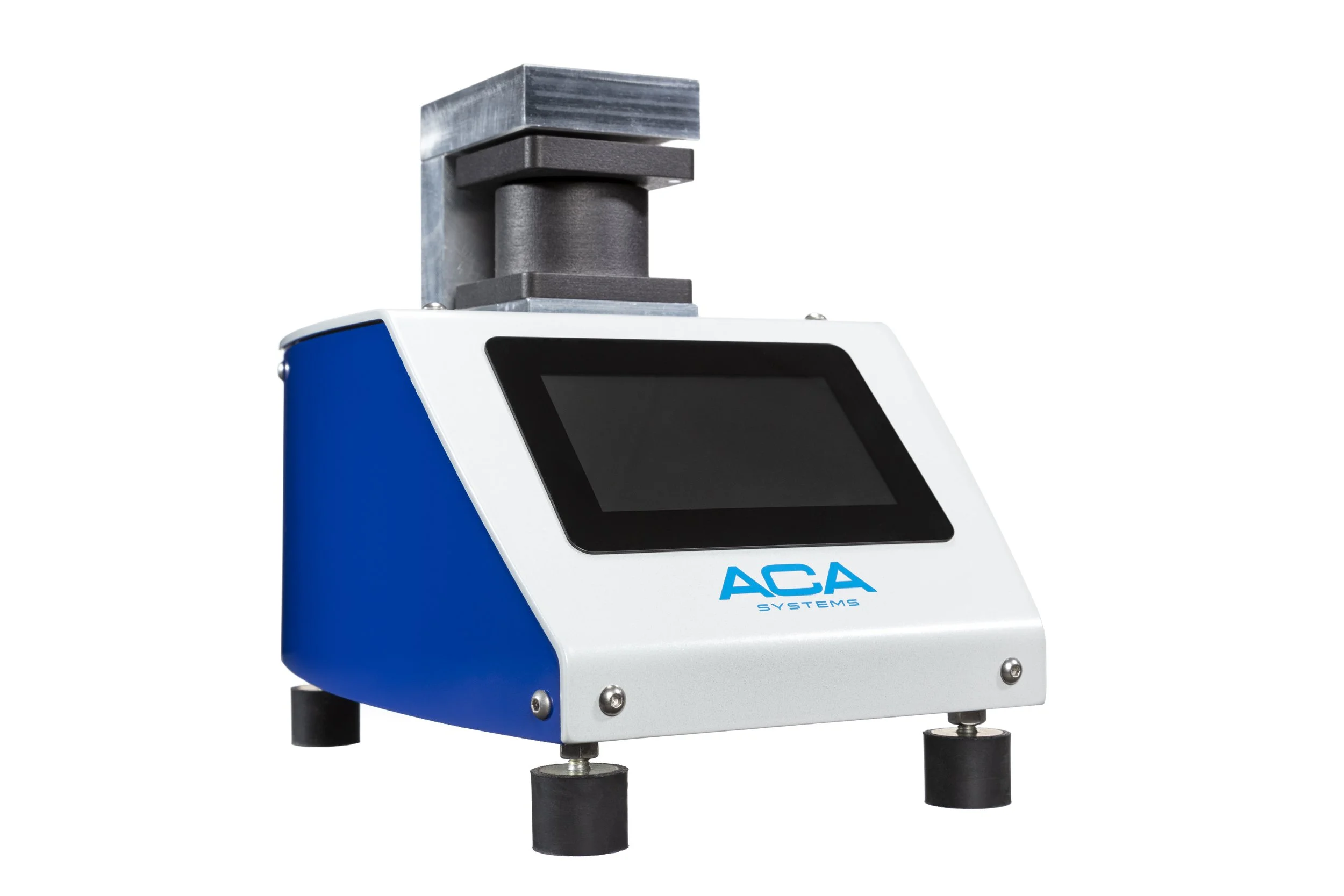
ACA Flow WR - For analyzing the coating color water retention
Water retention vs. dewatering
Water retention and dewatering describe the same phenomenon from opposite perspectives.
Water retention refers to how much water remains in the coating color during the test, whereas dewatering describes how much water leaves the coating during pressure filtration.
Consequently:
Low dewatering = High water retention
High dewatering = Low water retention
Throughout this article, dewatering values are used to illustrate how different formulations influence water retention performance.
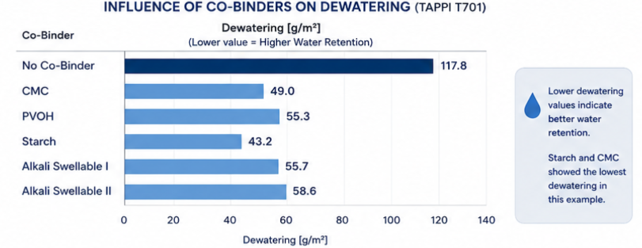
Influence of different co-binders on coating color dewatering. Lower dewatering values indicate higher water retention, highlighting the significant impact of binder selection on coating performance.
Why is water retention important?
Both excessively low and excessively high water retention can create production challenges.
Low water retention
When water retention is too low, water leaves the coating color too rapidly and the coating consolidates too quickly, often leading to coating runnability problems due to premature immobilization before the blade or nip
In severe cases, the coating structure may begin to immobilize even before reaching the blade or nip. Premature consolidation makes it more difficult for the coating to level properly and often results in runnability problems.
Typical consequences include:
Uneven coating distribution
Blade streaks and coating defects
Binder migration
Poor coating coverage
Reduced machine runnability
Increased risk of instability during coating
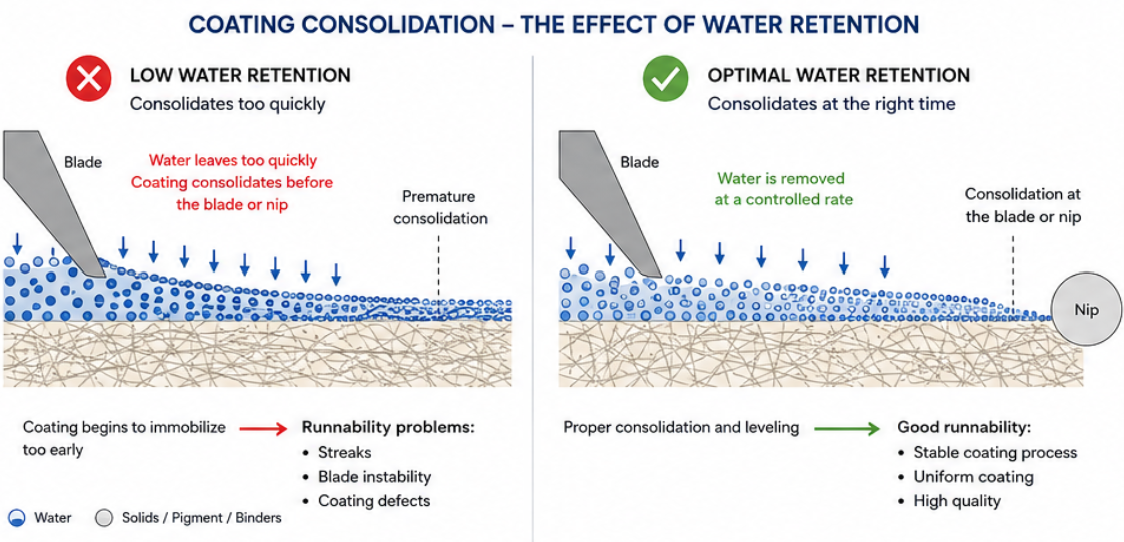
The effect of water retention on coating consolidation. Excessively low water retention causes premature consolidation before the blade or nip, leading to runnability problems and coating defects. Optimal water retention enables controlled dewatering, proper consolidation, and a stable coating process.
High water retention
Excessively high water retention can also reduce process performance.
If too much water remains in the coating after application, more energy is required in the dryers to remove the excess moisture.
Typical consequences include:
Increased drying demand
Higher energy consumption
Lower production speed
Reduced overall process efficiency
The optimal water retention always depends on the coating formulation, substrate and coating conditions. The objective is to achieve the right balance for each application.
More than a coating property
Water retention depends not only on the coating formulation but also on the characteristics of the base paper or board.
Porosity, absorbency and fibre structure all influence how quickly water penetrates into the substrate. As a result, the same coating formulation may perform very differently on different paper or board grades.
Small formulation changes—including binders, pigments, rheology modifiers and additives—can significantly influence water retention and therefore overall coating performance.
Adjusting water retention with rheology modifiers
Water retention can often be optimized by selecting suitable rheology modifiers or co-binders.
The example below illustrates how different co-binders influence dewatering during pressure filtration.
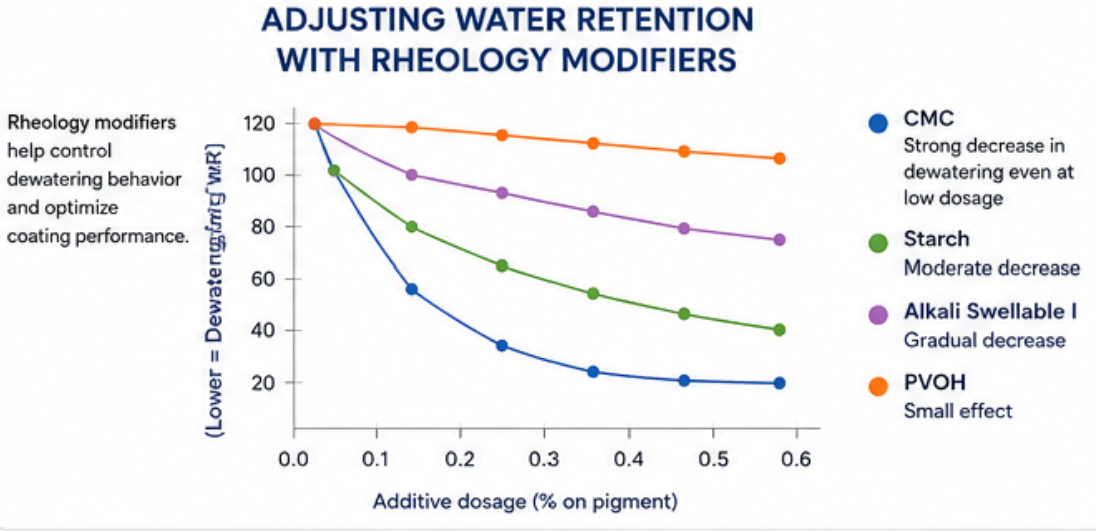
Effect of rheology modifiers on coating color dewatering. Lower dewatering values correspond to higher water retention.
In this example, formulations containing starch and CMC produced the lowest dewatering values, indicating improved water retention compared with the formulation without a co-binder.
Because dewatering and water retention are inversely related, a lower dewatering value means that more water remains in the coating during testing.
Rheology modifiers such as:
CMC
Starch
PVOH
Alkali Swellable polymers
are commonly used to fine-tune the balance between coating immobilization, runnability and drying performance.
A valuable process optimization tool
Water retention measurements help manufacturers:
Optimize coating formulations
Evaluate new raw materials
Troubleshoot coating defects
Improve process stability
Reduce production variation
Because water retention often changes before visible quality defects appear, it provides valuable information for both product development and process optimization.
Better control, better coating performance
As coating formulations become increasingly advanced and production targets continue to tighten, understanding water retention is no longer simply a laboratory measurement—it has become an important process optimization tool.
With fast, repeatable and user-friendly measurements, ACA Flow WR helps laboratories and production teams better understand coating behaviour, optimize formulations and improve overall coating performance.
Contact ACA Systems to learn more about ACA Flow WR!